
Your athletes’ capabilities in the countermovement jump, squat jump, and single leg jump can help them know where they are as athletes relative to where they should be to remain an athlete at the next level. Many of us dreamed of competing in athletics at the collegiate or professional level. Many also have kids that have that same dream. As we grow and get closer or further away from these goals, we realize that there’s no substitute for winning the genetic lottery and being born with an elite genome. If that’s you, congratulations, you’ve already done the hardest part of becoming the 7-8% of high school athletes that become varsity level college athletes. Of that number only 2% make it to become professional athletes.
The other component to becoming an elite or professional athlete is the work you put into it. There are a variety of sport specific skills, general exercises, conditioning programs, apps, influencers, etc. that you can look for help or inspiration. But this is one of the instances where comparison is not the thief of joy, but the harbinger of hope. There is now a way to compare yourself to the average athlete at your position. Utilizing force plates, and digital dynamometry at Invoke Therapy and Wellness we gather that data with you. From there you can target your interventions to fill any gaps in your resume and maximize your chances of reaching the next level.
Analytics and data have become ubiquitous across sport, and this is true of any sporting profession. These groups have been utilizing dynamometry and measuring ground reactive forces with force plates. At Invoke Therapy and Wellness you have the opportunity to utilize the same technology those athletes use to do the same tests, and profile yourself as the athlete you are, to best get yourself to become the athlete you want to be.
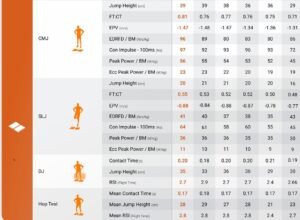
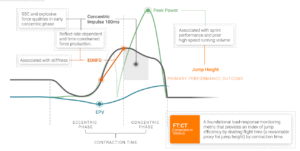
Most recently the English Premier League , NCAA men’s and women’s basketball, as well as NCAA and NFL football all utilized regular testing of their athletes to garner the most useful data related to their success and injury prevention. The testing utilized across all the different sports always included a countermovement jump (CMJ) and a single leg jump (SLJ). These two metrics provide a trove of information regarding power generation and force absorption and distribution.
Premier league athletes displayed a 5% higher value of eccentric deceleration rate of force development (EDRFD)compared to those in the Champions League. This is where the ability to make amazing cuts, and direction changes comes from. The same difference is noted in their flight time to contraction time ration (FT:CT). This is comparing how fast your muscles go from loaded to unloaded vs how high you get in the area. This power obviously translates directly to jumping for headers and such but is also telling of the power a snap kick can generate. Some things noted were jump height and power were higher earlier in the week, but peak performance for EDRFD and FT:CT was highest on Fridays. Neuromuscular performance was improved by the end of the season as evidenced by improved drop jump (DJ) measures.
NCAA basketball found through shoulder external and internal rotation testing that basketball predisposed participants to a level of anterior instability secondary only to football players. When comparing men and women men demonstrated a more efficient load response, while women demonstrated poor recovery, which could be related to insufficient conditioning.
When it comes to the NCAA vs NFL they both utilized. When it comes to the NFL vs the NCAA they both utilized the same testing as the Premier League but also had extra testing on hamstring strength. The greatest differences were noted in the strength and force dominant positions OL, DL, and TE’s. Skill positions were very similar between the pros and collegiate athletes. The biggest differences were noted in impulse differences between eccentric and concentric contractions. This illustrates that the pros manage forces better. The NCAA athletes were able to generate their jumps faster, but the NFL players jumped higher. NFL players also demonstrate a higher maximum downward speed. This is where the explosive power differences and speed of moves and cuts cross over into elite territory.
It’s the off-season for many sports. Take advantage of that rare increase in available time to visit us at Invoke Therapy and Wellness; establish a baseline that you can concretely build from with accurate data that leaves no doubts. This is information that your coaches, trainers, and therapists can use to help you reach that next level.