
Movement is medicine, so getting active and moving should be encouraged and facilitated whenever possible. Regardless of the intent behind the action, we often have aches and pains as unwanted but expected responses from said physical activity. Inflamed muscles and joints, calluses, shin splints are all examples of the price we might have to pay to make the quality of our lives better.
Whether these aches and pains are a result of an activity you have chosen or limit your ability to participate when you’d rather be going harder. taping is a safe, long lasting and efficient option to improve your motive experience in a variety of ways. And as PT’s are the experts on movement, we should be your first stop if you have any limitations, you want addressed.
You’ve doubtless seen a growing number of professional athletes sporting various patterns of tape, arms, legs, chest, back, neck; there’s a pattern and technique for just about any musculoskeletal condition you can think of. Beyond that there are ways to tape to facilitate and encourage certain movements and muscles. You can also utilize taping techniques to reduce activation of muscles, to lower risk of injury. Or even restrict unwanted movements.
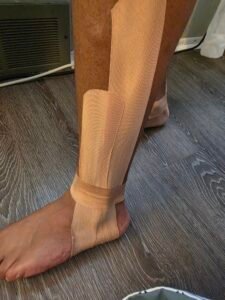
Theres a good bit of thought and science that has gone into the tape that is out there, but the three most prevalent in performance athletics are Kenesiotape, Active tape and Leukotape. Leukotape is the most restrictive, it’s good for changing movements through significant pull. This tape actually requires a barrier underneath it to not tear skin off. It should really only be used by professionals. Kenesio and active tape are more appropriate for general use. Both tapes are elastic, mimic skin, have heat activated elastic, and once applied typically last 3-5 days. The big difference between the two tapes is Kenesiotape only stretches the long way, active tape stretches all four directions. Both have practical applications and are useful in a variety of situations.
There are four key components to how the tape helps are as such:
- Supports muscle
- Improves contraction of weakened muscle
- Reduces fatigue
- Reduces over extension and over contraction of muscle.
- Reduces cramping and injury risk
- Reduce Swelling
- Removes congestion to the flow of body fluids
- Improves blood and lymphatic circulation
- Reduces excess heat and chemical substances in tissue
- Reduces inflammation
- Reduces abnormal feeling and pain in skin and muscle
- Activates Endogenous Analgesic Systems (Body’s own pain control)
- Corrects joint problems
- Adjusts misalignment caused by spasm and shortened muscle
- Normalizes muscle tone and abnormality of fascia in joints •
- Improves ROM
- Relieves pain
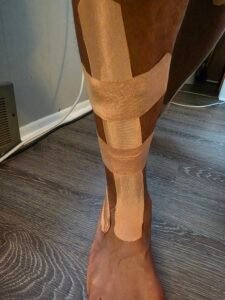
There are ways that you can apply these tapes to your own knee, ankle, wrist, or other accessible areas to gain these benefits for yourself, and here are some examples. But if the option is available, seeing a professional is your best option. Getting a detailed assessment and immediate assessment and feedback , as well as utilizing tape as a supplement for other treatments advantages you more than tape alone. So come see us at Invoke Therapy , and let us help you adhere to whatever goals you have for yourself and your healing.